Precinct planning, development and management
The Spatial Planning and Environment Directorate’s Departments for Urban Planning and Design and Urban Regeneration have a adopted a precinct-focused approach to planning, development and management. Find out more about this approach and the precincts identified for implementation below.
Cape Town 2050: The City of Cape Town’s long-term plan
Cape Town’s long-term plan describes the city as a dense, efficient, and climate-resilient metro. Our strategy focuses on releasing underutilised public land to create affordable housing near economic hubs, powered by sustainable energy and a circular economy.
A new approach to Urban Management
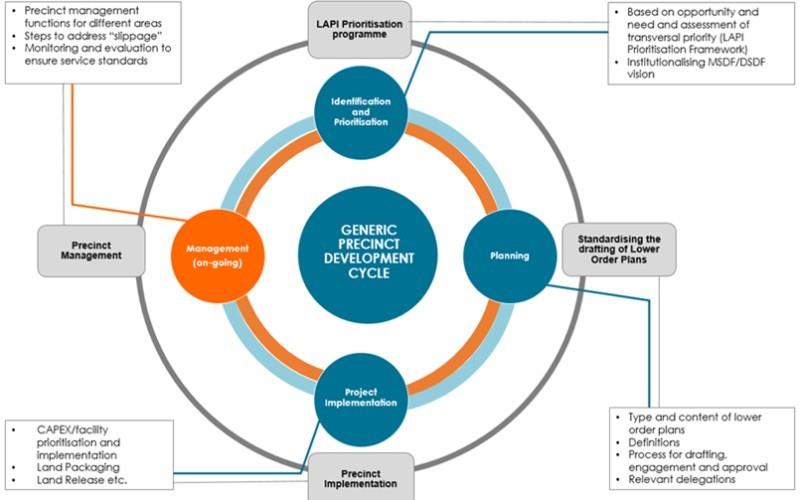
We are shifting how we develop key precincts by moving away from isolated projects toward a coordinated life-cycle model. This approach ensures every priority area benefits from:
-
Integrated Strategy: Total alignment across all City directorates.
-
End-to-end Planning: Custom life-cycle plans that cover everything from initial design to long-term maintenance.
-
Dedicated Resources: Ring-fenced budgets and human resources to ensure projects are not just planned, but built and managed sustainably.
Revitalising our city
This management style is designed to breathe new life into our downtown and inner-city areas, driving urban regeneration, restoring hope, and building a world-class built environment for all residents.
Precinct Planning
The following four Metropolitan Central Business Districts (CBDs) or precincts were identified in the approved City of Cape Town Municipal Spatial Development Framework (2023):
For each precinct, certain local area planning initiatives were completed, while maintenance and management arrangements have been established over time in the form of
City Improvement Districts (CIDs). Development Implementation Programmes are continuously updating and adjusting.
Local Area Planning Initiatives
To guide the growth of our neighbourhoods or areas, we use various lower-order planning tools. These frameworks ensure that every street, block, and precinct is developed in line with
Cape Town’s long-term vision.
Key Planning Tools
-
Urban Design Frameworks: Specific design guidelines for individual streets or blocks.
-
Precinct Plans: Detailed layouts for smaller groups of properties (erven).
-
Public Investment Frameworks: Roadmaps that define the roles and budgets of different City departments to ensure infrastructure is funded and maintained.
-
Local Spatial Development Frameworks (LSDFs): Comprehensive neighbourhood or area-level visions that guide land use and public investment in housing, transport, and social services.
Access our local area frameworks, policies and guidelines.
For an LSDF to take effect, it must be formally adopted by the City Council. These plans do not exist in isolation; they are designed to align with:
Precinct Development
Precinct development includes:
- Developing a strategy for the redevelopment or repurposing of public land assets.
- Step-by-step implementation plans to ensure the long-term infrastructure investment keeps up with and ensures the vision for the built environment is realised.
- Preparing legal documents and processes to ensure land parcels obtain higher development rights in line with the vision.
- Engaging property developers – be it residential, commercial or industrial – to redevelop their properties or enhance maintenance or renewal.
- Building partnerships with property owners and stakeholders to align actions needed for redevelopment, aligning budget availability, construction and implementation.
Precinct development assists with the following:
- Land use intensification to provide, for example, more residential units or commercial or retail floor space within the same location or the same space, and diversification (more land uses functioning in the same building or area).
- More opportunities for economic activities and for formal businesses and informal businesses to co-exist in the same built environment and space.
- Creative implementation of responsibilities and role division in day-to-day area cleanliness and security management.
- Coordination of initiatives and implementation of actions to establish a well-functioning and inviting public environment where people feel safe, can conduct their business, socialise and relax.
- Precinct development also supports compact cities and transformed urban spaces.
Precinct development is based on the following principles:
- Formulation and communication of a clear development vision and spatial plan/investment framework that can be implemented.
- Consolidation of coordinated and multi-disciplinary programmes and projects, which will result in integrated outcomes for precincts.
- Strong focus on coordination and transversal integration.
- Sector (plan and pipeline) based prioritisation and coordination in the targeted area.
- Prioritisation at community level (participatory planning).
- Not a ‘one size fits all’ approach – iteration and refinement required to suit local circumstances.
- Value creation, preservation and eventual capture (for re-investment).
- Programmatic approach (i.e. a programme of projects in a geographic area).
Precinct Management and Maintenance
Without management and maintenance of the central business districts, deterioration of the environmental quality and business operational space is highly likely and evident in many central areas of major metropolitan areas in South Africa.
In Cape Town, property owners wanting enhanced service delivery in their area can
establish a CID through a partnership with the City.
A CID is a specific area where property owners pay extra rates to fund enhanced, supplementary services like better safety, cleaning, and urban management, complementing the City's core services, with the most famous being the
Cape Town Central City Improvement District (CCID) managing the CBD.
There are several CIDs across Cape Town, all aiming to create cleaner, safer, and more vibrant neighbourhoods through public-private partnerships.
Key aspects of CIDs in Cape Town:
-
Funding: Property owners contribute additional rates, proportionate to property value, to fund top-up services.
-
Services: Focus areas include safety and security (patrols, law enforcement), urban management (cleaning, maintenance, green spaces), and social development.
-
Management: They are non-profit companies (NPCs) run by boards of property owners, working with the City for oversight and legal compliance.
-
Examples: The
CCID (CBD),
Sea Point CID,
Green Point and Oranje-Kloof CID (GP/OKCID), and
Welgemoed CID are active examples.
How they work:
-
Initiation: Property owners agree on a business plan for their area.
-
Approval: The City declares the area a Special Rating Area (SRA).
-
Operation: The CID entity manages the supplementary services, improving the local environment.
In essence, CIDs are a way for communities to invest in their immediate surroundings for better quality of life and stronger investor confidence.
Would you like to print this page?
print